Use familiar words in a new answer
Practise words you already know while asking for directions, describing an object, or reacting to a suggestion. The setting gives you clues without giving you the whole answer.
Portuguese speaking practice for everyday situations
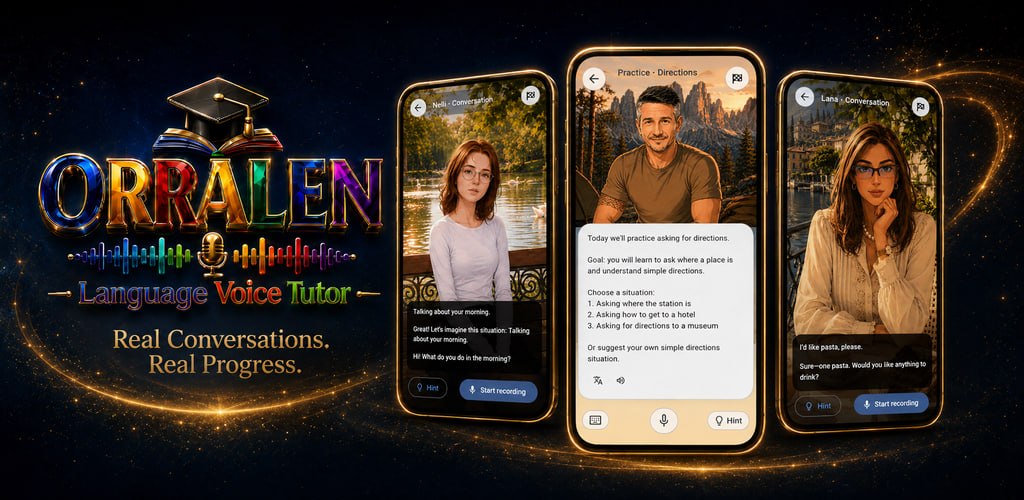
A phrase can look simple until you need to adapt it to a new question. Language Voice Tutor by Orralen offers Portuguese conversation practice through voice or text, helping you build useful responses for travel, work, study and daily life while the AI follows what you say.
Portuguese speaking practice is especially useful when you understand the topic but need time to put a response together. A simple situation helps turn familiar words into a question, explanation or decision.
Practise words you already know while asking for directions, describing an object, or reacting to a suggestion. The setting gives you clues without giving you the whole answer.
Beginners can practise clear, short patterns. Intermediate learners and students can connect past and present events, explain their reasons, and handle an unexpected follow-up.
Travellers can prepare practical questions. Workers can rehearse plans and updates. Anyone who wants more Portuguese conversation practice can create a regular time to speak.
Choose Portuguese, an A1, A2, B1 or B2 level, a topic or real-life situation, and an AI tutor. Respond by voice or type your answer. The next question follows what you have already said.
Begin at a station, an office reception, a university event or a neighbourhood café. A familiar place makes the purpose and useful words clearer.
The AI Portuguese tutor can ask what you mean, offer another route, or ask for a reason. You practise adjusting your message instead of only repeating one prepared line.
Compare your sentence with the corrected version. Notice one change in a word ending or word choice, make another example, and carry on with the same subject.
This Portuguese exchange uses common forms that remain understandable across many settings and leaves room to ask about distance or landmarks.
Tutor: Bom dia. Em que posso ajudar?
Estudante: Onde fica a estação, por favor?
Tutor: Claro. Siga em frente e vire à direita.
Estudante: Entendi. É longe daqui?
Try again: «Eu gosto muito de aprender novas idioma.»
Corrected: «Eu gosto muito de aprender novos idiomas.»
In Portuguese, idiomas is masculine plural, so the correct form is novos idiomas.
At each CEFR level, you can connect more information and respond more freely when the conversation changes direction.
Use greetings, numbers and short phrases to ask about places, prices and immediate needs.
Describe routines and recent activities, link basic details and make straightforward arrangements.
Tell a connected story, explain a practical problem and suggest what should happen next.
Compare alternatives, explain an opinion in more detail, and take part in a longer discussion.
Try the same language in different situations so it becomes easier to use outside one familiar dialogue.
Check a departure point, ask a host about public transport, or explain that a booking confirmation has not arrived.
Clarify who owns a task, present a short progress update, or propose a new time for a discussion.
Ask about course materials, compare notes after a lecture, or outline the main point of a group presentation.
Ask what comes with a dish, order for the table, respond to a suggestion, or request the bill.
Collect an order, ask about a repair, explain what you need in a shop, or check when a service closes.
Arrange a walk, discuss a shared hobby, or tell someone what you enjoyed about a recent weekend.
You do not need to find a conversation partner or coordinate a time. Start a short conversation when convenient, finish one useful task, and return often enough to keep important phrases fresh.
More than 100 guided lessons give you a step-by-step way to practise. You can also choose Lana, Nelli or David as your AI tutor and create a session around the situation you want to handle.
Register and get 7 days of Premium. The Free plan includes one free lesson every day.
Choose a new setting, reuse a correction from an earlier session, and notice when your answer begins to come more easily.
These answers can help you choose a level, a practice mode, and a useful everyday topic.
Yes. Choose A1 and a simple task such as greeting someone, buying an item, or asking where a place is. A complete short conversation is a useful starting point.
Begin with clear everyday phrases for common situations. Change the setting and details so that you learn to shape your own response instead of depending on one script.
Find the exact change, such as words that need to match in the plural, then create another sentence with a different noun or verb. Use it again while the topic is still fresh.
Yes. Text makes endings and spelling easier to check, while voice asks you to answer more immediately. In both modes, the next question follows the conversation.
Rotate a guided lesson, a travel task, a work or study conversation, and an everyday social topic. The 100+ lesson library and selectable AI tutors give you plenty of ways to change the subject.
Choose a CEFR level, enter a useful situation, and practise responding with Language Voice Tutor by Orralen.