
Use more of the English you know
If you know many words but pause when speaking, a familiar situation helps you bring them to mind, combine them, and finish your thought.
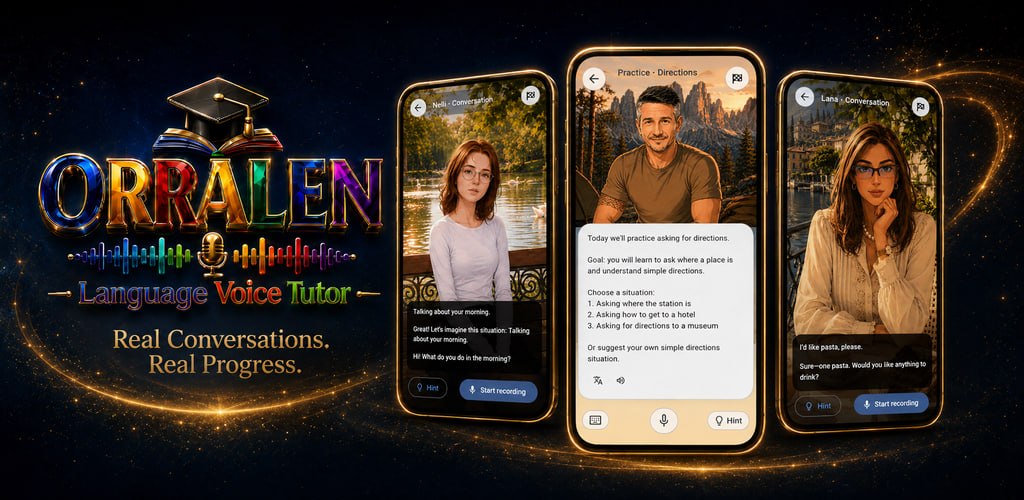
English speaking practice, whenever you have time
Move the English you recognise into sentences you can use. Orralen – Language Voice Tutor gives you English conversation practice by voice or text, follows the conversation, and helps you notice clearer, more natural ways to answer.
English speaking practice is useful when reading and listening feel easier than answering in the moment. The goal is not to recite perfect lines; it is to build the habit of forming a useful response and keeping the exchange moving.
If you know many words but pause when speaking, a familiar situation helps you bring them to mind, combine them, and finish your thought.
Beginners can rehearse short everyday exchanges, while intermediate learners and students can explain opinions, compare options, and ask more precise follow-up questions.
Travellers can prepare for practical encounters. Workers can practise introductions, requests and updates. Anyone who lacks regular conversation practice can return for a short session more often.
Choose English, set your CEFR level, pick a topic or situation, and select an AI tutor. You can answer by voice when you want speaking time or use text when you want to think carefully about sentence structure.
Start with a situation such as checking into a hotel, joining a project call, or chatting about weekend plans. Your level sets how simple or challenging the conversation will be.
The AI English tutor responds to what you have just said. Ask for details, change your mind, or clear up a misunderstanding as you would in a real conversation.
When a sentence needs attention, compare your version with a corrected or more natural alternative. Then continue the same discussion and look for a chance to reuse the pattern.
This café exchange practises a polite request, a follow-up choice, and a short answer. It is simple enough for an A1 or A2 learner but still feels like a useful conversation.

Tutor: Good morning. What can I get for you?
Learner: Could I have a flat white and a toasted cheese sandwich, please?
Tutor: Of course. Would you like to eat here or take it away?
Learner: I’ll eat here, thank you.
Try again: “I have lived here since three years.”
Better: “I have lived here for three years.”
Use for with a length of time. Since introduces the starting point, as in “since 2023.” The correction is specific enough to remember and reuse without stopping the conversation for a long grammar lecture.
The same topic can work differently at each CEFR level. As you improve, you can give more detail, react to surprises, and keep the conversation going for longer.
Exchange names, prices, times and basic preferences with short, supported phrases.
Connect simple sentences to describe routines, past activities and straightforward plans.
Explain reasons, tell a connected story and handle an unexpected turn in a familiar situation.
Compare viewpoints, explain an opinion carefully, and keep a longer conversation moving with more flexible wording.
A practical situation gives grammar and vocabulary a purpose. Rotate settings so that familiar phrases become adaptable rather than tied to one memorised script.
Clarify a platform change, ask whether breakfast is included, or explain a problem with a room reservation.
Give a brief project update, request a revised deadline, or welcome a new colleague to a team call.
Summarise an article, ask a lecturer for clarification, or discuss how to divide a group assignment.
Ask about ingredients, change a side dish, respond to a server, and settle the bill politely.
Arrange a repair, return an unsuitable item, speak to a neighbour, or make plans for the weekend.
Discuss a film, local news, hobbies or personal goals so that speaking English becomes part of your normal routine.
You do not need to find a conversation partner or schedule a call. Open a session when it is convenient, choose a five-minute exchange or a longer discussion, and come back to English more regularly.
More than 100 guided lessons give you a clear place to start when you want more structure. When you want open practice, choose an AI conversation partner such as Lana, Nelli or David and select the situation yourself.
Register and get 7 days of Premium. The Free plan includes one free lesson every day.
Use the daily lesson to make English conversation practice a regular habit, then decide how much practice works for you.
These answers focus on how an English practice session can fit different goals and confidence levels.
Yes. Begin with a familiar topic and a suitable CEFR level. Short follow-up questions help you use words you already recognise without asking you to prepare a long speech.
No. A1 and A2 sessions support everyday exchanges, while B1 and B2 practice can ask you to explain reasons, describe consequences, compare choices and maintain a longer discussion.
Yes. Choose voice when you want to practise forming spoken answers, or text when you want extra time to inspect wording. The conversation continues from the context in either mode.
Compare the two sentences, identify the changed pattern, and write or say one new example of your own. Reusing the pattern later in the same topic makes the correction more practical.
A short, regular session is easier to repeat than an occasional marathon. One free lesson per day provides a simple rhythm, and the guided library offers another topic when you are unsure what to practise.
Choose a level and a situation, answer in your own words, and keep the conversation moving with Orralen – Language Voice Tutor.