Use words you know from lessons and daily life
Turn Italian you recognise in films, lessons or reading into requests, descriptions and reactions. A clear situation helps the right words come to mind.
Italian speaking practice for real conversations
Italian can feel familiar when you hear it and suddenly harder when it is your turn to reply. With Orralen – Language Voice Tutor, you can practise speaking Italian through voice or text, take a situation beyond the opening line, and learn from clear corrections that reflect what you wanted to say.
Italian speaking practice helps turn familiar words into useful answers. Instead of waiting until every ending feels perfect, say what you can, see how the other person responds, and try again.
Turn Italian you recognise in films, lessons or reading into requests, descriptions and reactions. A clear situation helps the right words come to mind.
Beginners can practise greetings, quantities and basic questions. Intermediate learners and students can link events, explain preferences, and tell a clearer story.
Travellers can rehearse useful service conversations. Workers can practise updates and arrangements. Anyone who wants more regular Italian conversation can return without waiting for a group class.
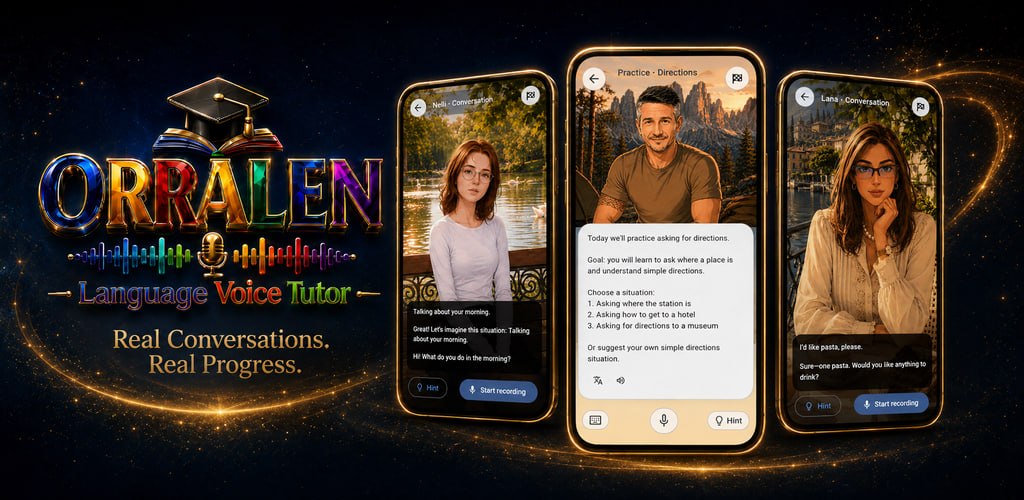
Select Italian, set a CEFR level, choose a topic or situation, and decide which AI tutor will take the other role. Answer by voice or text while the conversation keeps track of people, plans and details already introduced.
You might need to reserve a table, ask a colleague for help, or explain an idea to a classmate. A clear goal makes it easier to know what you want to say.
The AI Italian tutor can ask what time suits you, offer a different dish, or request another example. You practise responding to a change instead of completing a memorised dialogue.
A corrected or more natural sentence reveals one useful change you can try again. Make a second sentence with the same word ending or preposition, then return to the topic.
This conversation practises a reservation name, a polite welcome, and a question that could lead into seating or ordering.
Tutor: Buonasera, avete prenotato?
Studente: Sì, abbiamo un tavolo a nome Rossi.
Tutor: Perfetto. Preferite stare vicino alla finestra?
Studente: Sì, volentieri, grazie.
Try again: «Mi piace molto i piatti regionali.»
Corrected: «Mi piacciono molto i piatti regionali.»
Because i piatti regionali is plural, Italian uses piacciono here.
At each CEFR level, you can give more detail and respond more freely when the other person adds new information or sees things differently.
Use short phrases for identity, location, food, time and simple preferences.
Describe a normal day, talk about basic past events, and arrange familiar activities.
Tell a connected story, explain a goal, and solve an everyday problem through conversation.
Support an opinion, compare different views, and adjust your tone and detail in a longer conversation.
Change the place and the person you are speaking to, so you learn to use familiar Italian in more than one exercise.
Ask a host how to reach a hill town, change a ferry booking, or explain that your luggage has not arrived.
Welcome a visitor, summarise a client request, or suggest a practical compromise when two schedules conflict.
Describe the focus of a paper, compare lecture notes, or ask a classmate to rehearse part of a presentation.
Discuss regional dishes, ask for a different course, order coffee at the counter, or respond to a recommendation.
Find a local market, explain a maintenance problem, or ask when a community event begins.
Make weekend plans, talk about a family recipe, or tell a friend why you enjoyed a place they suggested.
There is no need to find a conversation partner or reserve a shared time. Open a situation when convenient, practise one complete conversation, and return before useful phrases fade from memory.
More than 100 guided lessons offer clear topics to follow. For a freer conversation, choose Lana, Nelli or David as your AI tutor and set the subject yourself.
Register and get 7 days of Premium. The Free plan includes one free lesson every day.
Use each daily lesson to enjoy a small success: make a clear request, understand a correction, or complete a longer answer without losing your train of thought.
Start with a situation you understand, but leave enough room to give your own answer.
Yes. Choose a small task such as ordering a drink, giving your name, or asking where something is. Completing a brief conversation gives you a base for longer answers.
Look at the corrected sentence, notice which words change with the noun, and make a new example with a different noun. A complete sentence makes the connection easier to see.
Use voice when you want to answer more immediately and text when you want to check spelling, articles or verb forms. You can study a pattern in text and then try it by voice.
Yes. A correction helps you express what you meant; it does not end the conversation. Notice the change, then answer the next question.
A guided lesson gives you a clear topic and goal. An open situation lets you use the same Italian with different people, details and outcomes.
Select a level and a situation, then let one answer lead to the next with Language Voice Tutor by Orralen.