Bring familiar words into conversation
If you understand more words than you use, a clear role and goal can help you bring verbs, nouns and linking phrases to mind and put them into complete sentences.
German speaking practice with a clear situation
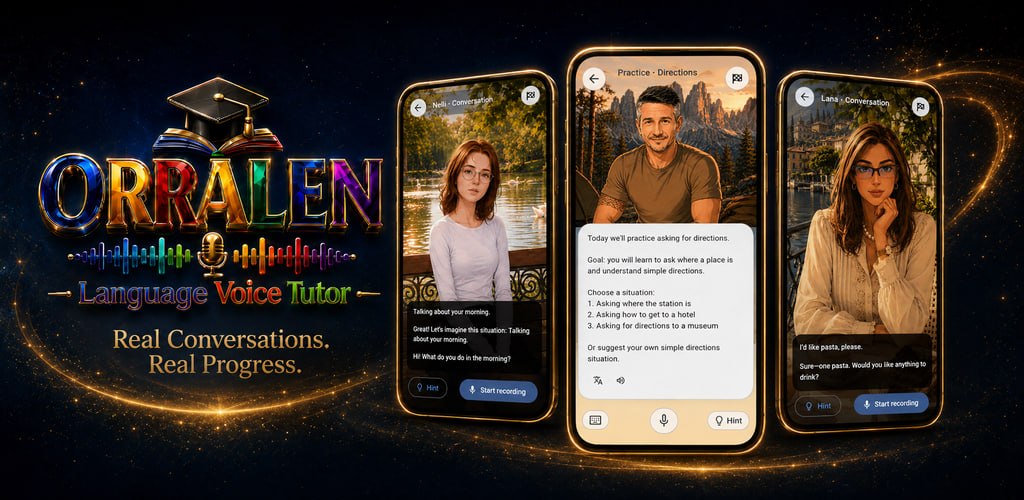
German often feels manageable on the page until a word ending, verb position, or unfamiliar reply appears in conversation. Orralen – Language Voice Tutor gives you a private place to practise speaking German, test what you can already express, and continue by voice or text without losing the thread.
German speaking practice helps with the moment between understanding a question and building a reply. Regular conversations make it easier to use grammar and vocabulary without planning every sentence in advance.
If you understand more words than you use, a clear role and goal can help you bring verbs, nouns and linking phrases to mind and put them into complete sentences.
Beginners can practise introductions, directions and purchases. Intermediate learners and students can describe a process, explain a choice, and join several ideas in one answer.
Travellers can rehearse transport or accommodation problems. Workers can practise meetings and formal requests. Anyone short of regular German conversation practice can create more chances to speak.
Select German, choose your CEFR level, decide on a topic or situation, and pick an AI tutor. Speak your response or type it. The next question follows what you have said, so a meeting can move from choosing a time to agreeing an agenda.
A workplace request may call for Sie, while a conversation with a friend can use du. The situation helps you practise the right tone as well as the vocabulary.
The AI German tutor follows the developing conversation. You can ask a follow-up, reject a suggestion politely, or add missing information instead of working through unrelated drills.
Compare your sentence with the corrected version. Notice one useful change—perhaps verb placement or a word ending—then try another answer with the same pattern.
This exchange practises availability, the common time expression halb zehn, and a clear agreement between colleagues.

Tutor: Haben Sie morgen Zeit für eine kurze Besprechung?
Lernende Person: Ja, morgen Vormittag passt es mir gut.
Tutor: Wie wäre es um halb zehn?
Lernende Person: Das passt. Ich schicke gleich eine Einladung.
Learner: „Morgen ich fahre mit dem Zug zur Arbeit.“
Better: „Morgen fahre ich mit dem Zug zur Arbeit.“
When the sentence starts with Morgen, the verb comes next. Here, fahre moves before ich.
Progress in German means gaining room to connect ideas, repair a sentence and respond to an unexpected detail.
Give basic personal information and complete short everyday exchanges with familiar phrases.
Describe routines, appointments and past activities in linked but uncomplicated sentences.
Explain a problem, narrate what happened and suggest a practical solution with reasons.
Develop a viewpoint, respond to objections and vary sentence structure through a longer conversation.
Move between formal and informal situations so that your German conversation practice is useful beyond one familiar script.
Ask about a missed rail connection, confirm where to validate a ticket, or report an item left at reception.
Set priorities for the week, explain a technical delay in plain language, or request feedback on a draft.
Arrange library work, compare research topics, or ask a seminar leader to clarify the next step.
Reserve a table, ask whether a meal contains a particular ingredient, and divide an order among friends.
Ask about opening hours, describe a parcel-delivery problem, or make an appointment for a service.
Talk about commuting, recommend a place in your city, or discuss how a new habit has changed your week.
Practise when you have time. You do not have to find a conversation partner or coordinate schedules, which makes a ten-minute German session easier to repeat.
The library includes more than 100 guided lessons. You can also choose Lana, Nelli or David as your AI tutor and start a situation that matches your goal.
Register and get 7 days of Premium. The Free plan includes one free lesson every day.
That daily lesson can support a simple routine: one conversation, one correction to reuse, and one sentence that feels easier next time.
Choose a situation you can complete, then add more detail as your confidence grows.
No. At A1 or A2, begin with a simple situation and short sentences. The conversation gives each grammar point a practical use, and a correction shows what to review.
Yes. Choose situations where the relationship is clear—a service encounter, colleague, classmate or friend—and pay attention to whether the conversation uses Sie or du.
Text shows the whole sentence at once. You can check where the main verb and time phrase appear, then return to voice and try another answer.
Describe what it does, ask for the word, or say the idea another way. Keeping the conversation moving is a useful skill at B1 and B2.
Choose a guided lesson when you want clear steps, then use the same words in a different open conversation. A new situation helps you find out what you can use without prompts.
Choose a level and situation, respond in your own words, and use each correction in the conversation that follows.