Use the French you already know
Familiar verbs, linking words and polite phrases become easier to remember when you need them for a real purpose. The situation gives you a starting point, but the answer is your own.
French conversation practice for everyday encounters
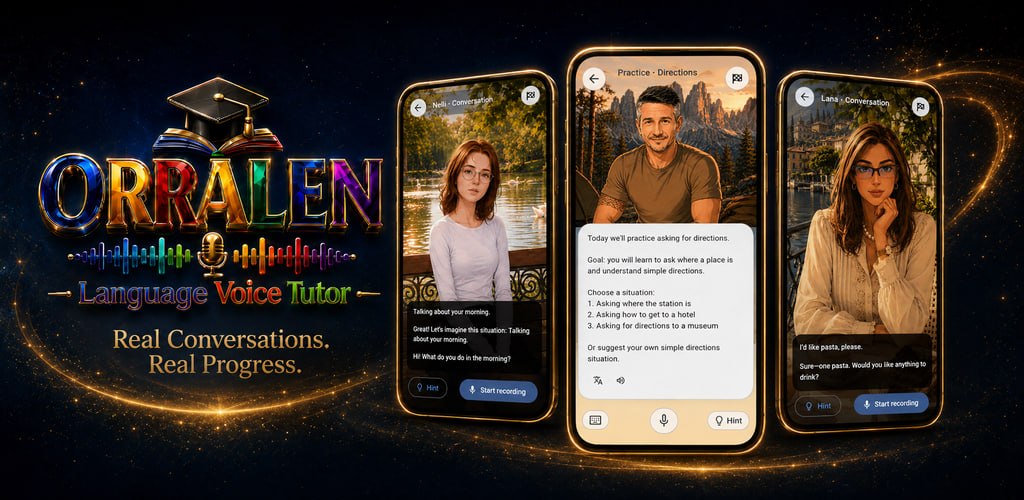
Make the step from understanding a French phrase to choosing one yourself. Language Voice Tutor by Orralen lets you practise speaking French in voice or text conversations that respond to what you have already said, whether you are buying a ticket, meeting a colleague, or catching up with a friend.
A notebook full of vocabulary does not automatically make a restaurant question or a station announcement easy to answer. Regular conversation practice helps you turn familiar French into an answer when you need it.
Familiar verbs, linking words and polite phrases become easier to remember when you need them for a real purpose. The situation gives you a starting point, but the answer is your own.
Beginners can practise greetings and simple requests until they feel comfortable. Intermediate learners and students can tell a story, explain a preference, or clear up a misunderstanding.
Travellers can rehearse transport and accommodation. Workers can practise courteous questions and updates. People without regular French conversation practice can create a repeatable routine at home.
Select French, an A1, A2, B1 or B2 level, a topic or situation, and an AI tutor. Answer aloud by voice, or type when you want more time to think about your wording.
Ask for a train connection, introduce yourself at a conference, or plan an evening with friends. A clear purpose makes each new word easier to place in context.
The AI French tutor follows the ongoing situation. If you ask about departure time, the next turn can concern the platform, the fare, or a delay instead of resetting to an unrelated question.
Corrections show how your sentence could sound clearer or more natural. Compare the two versions, make another example, and then carry on with the conversation.
This short French dialogue practises a polite request, useful train vocabulary, and the difference between a single and return journey.

Tuteur : Bonjour, je peux vous aider ?
Apprenant : Oui, je voudrais un billet pour Lyon, s’il vous plaît.
Tuteur : Un aller simple ou un aller-retour ?
Apprenant : Un aller-retour pour demain matin.
Try again: « J’ai besoin de pratiquer mon français plus. »
More natural: « J’ai besoin de pratiquer davantage le français. »
Here, davantage makes the sentence sound more natural.
CEFR levels change the amount of support, detail and flexibility expected from the conversation, not simply the length of a vocabulary list.
Use names, numbers, dates and memorised polite forms to complete a short everyday task.
Describe a routine, link a few past actions, and ask uncomplicated questions about familiar needs.
Tell a clear story, explain a preference, and find another way to express an idea when a word is missing.
Explain a viewpoint in detail and move more comfortably between formal and relaxed conversations.
French conversation practice is easier to remember when you know where you are, who you are speaking to, and what you need to do.
Confirm whether a train requires a reservation, ask a hotel to store luggage, or seek directions after leaving the métro.
Introduce your responsibilities, rearrange a meeting, or explain politely why a delivery date has changed.
Discuss a reading, compare interpretations with a classmate, or ask for a missing detail about an assignment.
Request a table on the terrace, ask how a dish is prepared, and respond when the server suggests a dessert.
Collect a parcel, describe what you need at a pharmacy, or ask a shop assistant whether another size is available.
Talk about a neighbourhood, recommend a book, or explain how you spent a holiday without following a fixed script.
You can practise when a spare moment appears, without finding a conversation partner or coordinating a call. A short exchange before a journey and a longer weekend discussion both count as useful repetition.
There are more than 100 guided lessons when you want a clear lesson to follow. For open practice, choose Lana, Nelli or David as your AI conversation partner, then select a topic suited to the French you need.
Register and get 7 days of Premium. The Free plan includes one free lesson every day.
That daily lesson makes it easier to build a French practice routine and keep useful words fresh.
Use these answers to choose a level, mode and routine that match the French you want to use.
Yes. At A1, choose a narrow task such as buying a ticket or giving your name. Short turns and familiar information make it easier to complete an exchange before adding detail.
A written correction can show which words need to match in a complete sentence. Build another sentence with the same pattern instead of memorising the correction alone.
Try the clearest sentence you can form. The value comes from making a choice, seeing a useful alternative, and continuing. Waiting for a perfect answer can reduce the amount of active practice.
Yes. Voice is useful when you want to produce an answer directly; text gives you time to study spelling and sentence shape. Both modes keep the conversation connected to the chosen situation.
Alternate a guided lesson with a real-life scenario, and keep a short list of patterns you want to reuse. One free lesson per day offers a natural prompt to return.
Choose your level, enter a useful situation, and practise speaking French with an AI tutor that follows the exchange.